Tuesday, May 1, 2012

SynthEyes Info

We will be doing most of our matchmoving using SynthEyes, an appreciably powerful piece of matchmoving software. You can download a trial version of the software at:
ssontech.com/demo/
(user and pw given out in class, or fill out the trial info to get your own email with info)


Tutorial Wise - Here are some good starting points:

Youtube Playlist of Tuts (EASY):
http://www.youtube.com/playlist?list=PL603E51EFA3DD233C

SynthEyes' own Learning Site:
http://ssontech.com/learning.htm

Adavanced Tutorial (Do this if you want to take this technique seriously):
http://www.youtube.com/watch?v=dipTbUkAXZk


PROJECT 2 In Progress:
For Tuesday: Storyboard, plan and shoot video footage for a 1 minute animation/composite.
This project will use MatchMoving as a visual technique, so plan on establishing a video narrative/scene with straight footage, then plan on compositing in 3D footage on top.

For matchmoving examples, consider:
vimeo.com/7400277


vimeo.com/7993383

http://gawker.com/5512689/attack-of-the-pixels


Blender Improvements

Big news in  the Blender world. First, a new version has been released (2.63) and there has been a big changes in the mesh modeling system. The software now support N-Gons (more than quads and triangles). Also the new rendering engine cycles has been updated, plus other things:


--------------
Another sidenote, if you want to check out a very cool modeling aid called BSurfaces, it may be worth your time. It used to be commercial ($39) and it has just been released under a free (GPL) licence.
HERE

Thursday, April 12, 2012

Research Project 1 - Svankmajer & Quay

As you move along and start to synthesize the various animation techniques learned in class thus far (Object based, ShapeKeys, Array, Curve/hooks), I want you to start thinking about creating your first experimental animation. This will be a bonafide project that will move beyond tests and into the realm of concepts and skilled execution.

Start by watching animation by Jan Svankmajer (youtube, vimeo and other other sources). In particular, check out Dimensions of a Dialogue.


Secondly, check out works by the Brothers Quay. If you have netflix, check them out HERE
Otherwise, hunt around YouTube, etc.


Your first project will be to create an experimental animation that is steeped in a central concept of your choosing, and which is technically considered (no tests, plenty of time and nuance).

Come to class on Tuesday with three distinct ideas. Try to purge conventional Disney/Pixar narrative from your mind, and invite abstractions, surrealism, minimalism and gesture. I will be meeting with each of you one on one to talk about those ideas, so make sure you spend a couple hours (not 15 minutes) developing the concepts. Ask yourself how you can avoid the expected, the cliche and the cutesy narrative and create something altogether different.

If you have questions, email me.

Meischeid Animation - made in Blender

Rigging Characters


If you really enjoy rigging characters and/or are interested in character animations, you may want to get a more in depth tutorial at blender cookie.


Also, if you want to deconstruct some really high-end rigs used for animation, check out these:

Tuesday, April 10, 2012

Looking at the 12 Principles of Animation

Classical animator pioneers Ollie Johnston and Frank Thomas, both veterans from Disney, describe twelve vital aspects of animation in their 1981 book 'The Illusion of Life: Disney Animation'. This week we will explore armatures and look at two of these twelve principles ; squash/stretch and anticipation. From wikipedia:
------------------------------------------------

Squash and stretch

Animated sequence of a race horse galloping. Photos taken by Eadweard Muybridge. The horse's body demonstrates squash and stretch in natural musculature.
The most important principle is "squash and stretch",[4] the purpose of which is to give a sense of weight and flexibility to drawn objects. It can be applied to simple objects, like a bouncing ball, or more complex constructions, like the musculature of a human face.[5][6] Taken to an extreme point, a figure stretched or squashed to an exaggerated degree can have a comical effect.[7] In realistic animation, however, the most important aspect of this principle is the fact that an object's volume does not change when squashed or stretched. If the length of a ball is stretched vertically, its width (in three dimensions, also its depth) needs to contract correspondingly horizontally.[8]

[edit]Anticipation

Anticipation is used to prepare the audience for an action, and to make the action appear more realistic.[9] A dancer jumping off the floor has to bend his knees first; a golfer making a swing has to swing the club back first. The technique can also be used for less physical actions, such as a character looking off-screen to anticipate someone's arrival, or attention focusing on an object that a character is about to pick up.[10]
Anticipation: A baseball player making a pitch prepares for the action by moving his arm back.
For special effect, anticipation can also be omitted in cases where it is expected. The resulting sense of anticlimax will produce a feeling of surprise in the viewer, and can often add comedy to a scene.[11] This is often referred to as a 'surprise gag'.[12]


------------------------------------------------


Homework Week 2


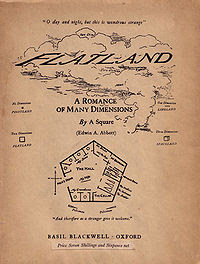
For Thursday of Week 2,  read PART I of the 1884 classic book 'Flatland: A Romance of Many Dimensions'. Write a three paragraph blog post responding to the content of Part I of Flatland.
This is a fascinating read not only for its historical precedence, but also because Abbot writes eloquently on how one can anthropomorphize 'citizens' of different dimensions. 
Because the copyright is expired on this book, it can be found in many locations. Choose the one with the friendliest formatting to your eyes.